Categories
Coaching Life Coaching

Transform Your Life: Mastering Time Management and Priorities

Hey everyone! Stephen here 😊

Sometimes, a nugget of wisdom sticks with you for whatever reason. I recently heard on a podcast someone drop in the phrase “If you want to know someone’s priorities, look at their calendar”, before moving quickly on to the next topic. But this advice resonated deeply with me and sparked a significant change in how I manage my time.

Have you ever looked back at your week and wondered where all your time went? A few weeks ago, I had one of those moments. Between work, errands, and binge-watching Shogun on Disney+, my days were slipping by without me even realising it. 

That’s when the phrase from that podcast jumped back into my head and it got me thinking: how we spend our time truly reflects our priorities. So, I started changing the language I used… I shifted from “I don’t have time” to “That’s not a priority for me at the moment.”. For me, that subtle shift added accountability and more ownership of how I spent my time. 

So, if you’re feeling like your time is running away from you, stick around. Today, we’re diving into how to align your schedule with what really matters to you.

Time management priorities

Understanding Priorities

Priorities are the things that we deem most important in our lives. They are the values and goals that we aim to achieve and uphold. But here’s the kicker: if you’re not actively prioritising them, they often get lost in the shuffle of everyday life. It’s like trying to keep a cat off the kitchen counter – a futile effort… unless you’re really committed. And competitive. 

Why Knowing Your Priorities Matters

Knowing your priorities is crucial because it helps you make conscious decisions about how you spend your time. According to highly effective person Dr. Stephen Covey, author of “The 7 Habits of Highly Effective People,” effective time management isn’t about doing more; it’s about doing what’s most important.

Maybe you can resonate with being swamped with work, overwhelmed, yet still somehow finding time to scroll through social media for hours… (seriously, looking up my screen time made me change a lot). 

Maybe social media is one of your priorities. If so, great! For me though, it wasn’t. But I was nailing social media like it was one of my priorities. But it was an autopilot reaction. It hit me then – my actions (and therefore my actual priorities) weren’t aligning with what I wanted my priorities to be.

Instead of conquering my to-do list, I was becoming a champion of the latest DIY “build your own fridge entirely out of upcycled pallet wood” videos. It was like trying to fill a leaky bucket with water and wondering why my feet were always wet. Life, in its whimsical way, has a knack for showing us where our hearts truly lie, often through the most mundane of activities.

Practical Steps to Identify and Set Priorities

Let’s get practical! Here are some steps to help you identify and align your priorities with your daily activities:

🌟 Reflect on Your Values – Take a moment to think about what’s truly important to you. Is it family, career, health, or personal growth?

🏃‍♀️ Set Clear Goals – Once you’ve identified your values, set specific, actionable goals. For instance, if health is a priority, set a goal to exercise three times a week. (Need a hand goal-setting? Download my free worksheet!)

Track Your Time – Spend a week tracking how you spend your time. Apps like Toggl (not sponsored), checking your screen time, or just a simple journal can help you see where your hours are going. Spoiler alert: you might be surprised by how much time you spend scrolling through Instagram.

🌱 Evaluate and Adjust – After tracking your time, evaluate if it aligns with your priorities. If not, make adjustments. This might mean cutting back on TV time to fit in a workout or dedicating an hour each morning to personal development.

🗓 Create a Routine – Plan your days and weeks around your priorities. Use tools like calendars or planners to block out time for what matters most. It’s like setting a date with yourself. And you best not be ghosting yourself.

Shifting Your Mindset: From “I Don’t Have Time” to “That’s Not a Priority”

One of the most powerful shifts you can make is changing your language from “I don’t have time” to “That’s not a priority for me at the moment.” This shift puts the ownership back on you and makes you aware of your choices. It’s not about time; it’s about priorities.

When I started doing this, it was a game-changer. I realised that I wasn’t going for a run because I didn’t have time; it was because I wasn’t prioritising it. So, what was I prioritising instead? Viral dance videos. (Hey, they’re addictive…OK? It’s a real thing.) This honest reflection made me realise that I needed to start prioritising running. As soon as I acknowledged that, I could challenge myself to make running a priority. It was a wake-up call and exactly what I needed to shift my focus.

Common Obstacles and How to Overcome Them

We all face challenges when trying to align our time with our priorities. Here are a few common obstacles and how to tackle them:

🚫 Procrastination: It’s easy to put off important tasks. Try breaking them into smaller, manageable steps and reward yourself for completing them. As the old saying goes, “How do you eat an elephant? One bite at a time!” (Not that I endorse eating elephants, of course. They have wise eyes.)

🔔 Distractions: Minimise distractions by setting boundaries. This might mean turning off notifications during work hours or creating a dedicated workspace. Let’s be real – the world won’t end if you don’t reply to that WhatsApp message immediately.

🛑 Overcommitment: Learn to say no. It’s better to commit to fewer things and do them well than to spread yourself too thin. Remember, you’re not a superhero – even though your to-do list might make you feel like one.

Expert Insight

World champion of not using email, Dr. Cal Newport, author of “Deep Work,” (book review coming soon!) emphasises the importance of focused time blocks. He suggests, “The ability to concentrate intensely is a skill that must be trained.” By setting boundaries and dedicating time to your priorities, you can achieve greater focus and productivity. Think of it as training a puppy – with patience and consistency, it gets easier. It also gives you a bit more self-compassion… because you might kick yourself, but you wouldn’t kick a puppy.

Or why not try creating your own 30-day challenge?? More on that in a previous blog post here.

The Positive Impact of Prioritising Your Time

When you align your time with your priorities, the benefits are immense:

🧘 Improved Mental Health: Reducing the chaos in your schedule can lower stress and increase your overall well-being. It’s like clearing out the clutter in your house – suddenly, everything feels lighter.

Enhanced Productivity: Focusing on what truly matters boosts your productivity and helps you achieve your goals faster. It’s like driving on a clear road compared to navigating through traffic – you get to your destination much quicker.

👨‍👩‍👧 Better Relationships: Prioritising time for loved ones strengthens your relationships and creates lasting memories. It’s like watering a plant – with care and attention, it blossoms.

Conclusion

So there you have it! By understanding your priorities and making conscious choices about how you spend your time, you can lead a more intentional and fulfilling life. 

Remember, it’s not about doing more; it’s about doing what’s important. What steps will you take today to align your time with your priorities? Share your thoughts in the comments below, and let’s inspire each other to live our best lives! 💪

See you next time,

Stephen


If you’re interested in personal development and self-improvement, why not sign up for my weekly(ish) newsletter where you’ll find practical tips and join a budding community of improvers!
Categories
Coaching Life Coaching

Screw Motivation, Use Systems Thinking for Personal Development

Hey everyone, Stephen here 😊. Let me introduce you to ‘Systems Thinking for Personal Development’ – One concept that has given me and my clients a lot of success.


Ever find yourself pumped about a new goal, only to see that motivation fizzle out in a matter of weeks? Even with my experience as a life coach and knowledge of human psychology, I still get caught in that same cycle sometimes! 

Does this sound familiar? You set a sparkly new goal, get all fired up, and then a few days later… nothing. Excitement vanished. Back to square one.

Well, you’re not alone (there are at least two of us!), and, luckily there’s a smarter way to approach personal development, and it doesn’t rely on fleeting motivation. Let me introduce you to a concept called ‘Systems Thinking’ – which I promise is not as complicated as it sounds. Let’s dive in.

What Is ‘Systems Thinking’?

Systems thinking is stepping back and looking at the bigger picture. Instead of focusing on individual tasks or goals, you create a system that naturally leads to success. Think of it as designing your environment and habits to work for you, not against you. 

All-around clever business bloke (to use his full title) Dr. W. E. Deming stated that “Every system is perfectly designed to get the result that it does”.

Now Deming was talking about business, but this approach isn’t just for engineers or business strategists; it’s a game-changer for personal development too. Let’s explore how we can apply it. 

Why Motivation Isn’t Enough

Motivation is a sugar rush. It feels great at the start, but it doesn’t last. According to habit hero James Clear, author of “Atomic Habits”, relying solely on motivation is like running on a treadmill: you’re expending energy but not necessarily getting anywhere. The key to improving is to create a sustainable system that keeps us on track even when our initial enthusiasm wanes.

Systems thinking for personal development
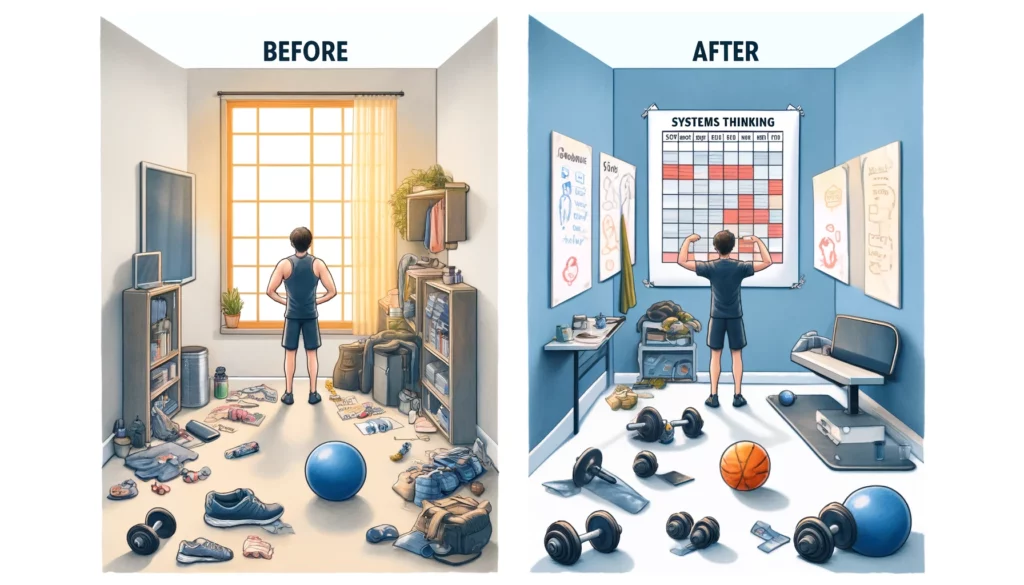
Even Systems Thinking can’t make some people tidy… Look how happy he is without a window, though.

The Importance of Systems

Imagine trying to grow a garden without setting up proper irrigation or choosing the right plants for your soil. You’d be frustrated with the lack of results, right? The same goes for personal development. Without the right systems in place, we’re setting ourselves up for failure. Systems thinking helps us focus on the processes and routines that lead to achieving our goals, making success almost inevitable.

Personal Story: My Shift to Systems Thinking for Personal Development

A few years months hours ago, I was struggling to stick to a fitness routine. I’d start strong, but my motivation would dip, and I’d skip workouts. Then, I discovered systems thinking. Instead of relying on motivation, I created a system: I set up my workout clothes the night before, scheduled workouts at a consistent time, and (because I’m a sucker for peer pressure) I found a workout buddy. This system made it easier to stick to my routine, and I started seeing real progress.

Practical Steps to Implement Systems Thinking for Personal Development

  • 📌 Identify Your Goals: Start with clear, specific goals. What do you want to achieve?
  • 📝 Break Down the Process: Identify the steps needed to reach your goals.
  • 🗓️ Create a Routine: Design a daily or weekly routine that incorporates these steps.
  • 🛠️ Set Up Your Environment: Arrange your environment to support your routine. For example, keep healthy snacks visible if you’re trying to eat better.
  • 📊 Track Your Progress: Use a journal or app to monitor your progress and make adjustments as needed.

Overcoming Common Challenges

Transitioning to systems thinking can be tough. You might miss the instant gratification that comes with initial motivation. But remember, systems thinking is about the long game. I’ve spoken about Mindset Maestro Dr Carol Dweck in my blog previously. She emphasises the importance of a growth mindset – believing that abilities can develop through dedication and hard work. When setbacks happen, see them as part of the process and learn from them.

The Positive Impact of Systems Thinking for Personal Development

When I embraced systems thinking, the benefits were incredible. I wasn’t just more consistent with my workouts; I felt less stressed and more in control of my life. Instead of feeling bad and chastising myself for not working out, I started to view it as an experiment. Instead reacting more along the lines of: “Well that didn’t work, I clearly haven’t figured out the right system yet… let’s tweak a few things”. 

Systems thinking doesn’t just help you achieve your goals; it creates a structure that supports ongoing growth and improvement.

Conclusion

So, if you’re tired of relying on motivation and ready to see real, lasting change, it’s time to embrace systems thinking. Set up your environment, create supportive routines, and watch as your goals become achievable milestones. What systems can you implement today to move closer to your goals? 

Share your thoughts in the comments below or book a session to learn more about how systems thinking can transform your life. Looking forward to hearing from you!

See you next time,

Stephen


If you’re interested in personal development and self-improvement, why not sign up for my weekly(ish) newsletter where you’ll find practical tips and join a budding community of improvers!
Categories
AI Coaching Coaching Life Coaching

How to Make ChatGPT Your FREE Life Coach

Hey everyone! If you’re reading this you likely fall into one of two camps: you’re already sold on the benefits of AI and will give this a try straight after reading, or you’re still wary about AI and are wondering why everyone has forgotten about what happened with Skynet…

Well, fear not, by the end of this blog post, you’ll have all the information you need to turn your friendly AI chatbot (like Gemini, or ChatGPT) into your very own FREE AI Life Coach!

… Well… Sort of.

I previously explored leveraging ChatGPT for personal growth, but their new voice chat feature is a game changer. Let’s dive in and see how to use this for self-improvement, with a healthy dose of reality (because a robot therapist isn’t quite there… yet).

ChatGPT Life Coach AI

ChatGPT Life Coach: How to use AI for Self-Improvement

First things first: ChatGPT can’t replace a real-life coach. For all its incredible functionality, it’s still a relatively blunt instrument in comparison. It can’t read body language, give you time and space to think, or the constructive challenges that you’d get from a good coach.

That’s not to say it doesn’t have its uses, however! If you imagine a spectrum of self-reflection tools; on one end you have journaling; on the other, life coaching. ChatGPT is a lot closer to the journaling side of things but with an interactive twist. In fact, it can be useful to think of it as a fancy, interactive form of journaling.

That said, in my two weeks of testing the voice chat function, it did some things amazingly well:

  • 📝 Automatic Transcripts: No more forgetting key takeaways (big for me) or pausing to write notes!
  • 👌 Crystal Clear Understanding: ChatGPT picks up your voice and interprets it accurately (even if there were a couple of times my Derby accent was misinterpreted for Danish for some reason…)
  • 🤙 Hands-Free Coaching: Chat on the go – perfect for “external processors” like me who benefit from talking things out and think better while walking

Maximising your AI Life Coach: Top Tips

Now, I’m no expert in AI, but here are some insights from my experience as a life coach and psychologist, and some tips on how to get the best out of your new pocket coach:

  • 🎯Specificity is key: Provide clear details about what you need help with. The more specific you are, the more tailored ChatGPT’s responses will be.
  • 🤔 Open-ended questions: Ditch yes-or-no questions and opt for prompts that encourage deeper exploration and reflection.
  • 📃 Set intentions: Before jumping into a chat, take a moment to set goals for the conversation. What do you hope to achieve? What are you struggling with?

My personal tip: Treat your ChatGPT Life Coach as an experiment at the beginning and try a few different prompts – keep tweaking until you find something that works for you. It’s a little like getting to know your coach… sometimes it takes a little while to build rapport and for you to get to know each other. Here’s a prompt I’ve been using to get you started:

“I’d like you to take on the role of my personal life coach who has 20 years’ worth of experience in their field and is an expert in human psychology. I’m seeking guidance and support in [insert specific area or topic you’d like to explore, such as personal development, relationships, career goals, etc.]. Could you please provide prompts, and insights and summarise my thoughts to help me gain clarity and make progress in this area?”

ChatGPT Life Coach: Pros and Cons

So, as a professional life and personal development coach, what are my experiences of using ChatGPT’s voice chat in this context so far?:

Advantages:

  • 🤯 Great for Clearing Your Head: Head feeling full? Need a quick brain dump? A 10-minute chat with your ChatGPT Life Coach can be a great way to gain clarity.
  • 🕛 Accessibility: Available 24/7 with an internet connection, making it a convenient and on-demand resource for support.
  • 💷 Affordability: Completely free to use, making it accessible to everyone, regardless of budget.
  • 📒 Voice Chat Transcripts: No more forgetting key points, or needing to scribble thoughts down! ChatGPT automatically records voice chats for later reference.

Disadvantages:

  • 🚫 Interrupting Your Flow: This was my biggest frustration when I was walking and talking with ChatGPT. It can interrupt you mid-thought, forcing you to repeat yourself and hindering the natural flow of thoughts and ideas.
  • 👂Silence and Body Language: ChatGPT struggles with silence and can’t read your body language, which can limit its effectiveness in uncovering deeper insights. And is one of the key benefits of coaching.
  • 🥰 Limited Emotional Connection: Lacks the empathetic understanding and emotional support a human coach offers, which can be crucial for complex emotional issues.
  • 🧮 Data-Driven, Not Emotionally Aware: Responses are based on patterns and data, not real-time understanding of your emotions and situation. This may lead to less accurate or relevant advice.

Important Note: While ChatGPT is a great tool for clarifying thoughts or transcribing ideas, it’s not a replacement for therapy or counselling. If you’re struggling with a specific issue, please seek professional help.

Embrace Your Growth Journey with Your AI Life Coach

ChatGPT can be a powerful tool for personal development, especially if you struggle with traditional journaling.  It won’t replace human coaching, but it’s a valuable addition to your self-improvement toolbox.

So, my experience of using ChatGPT as my personal life coach for the past couple of weeks…

Is it a panacea? No. Does it replace traditional human coaching? No. But is it a really useful tool that has the potential to develop even further? Definitely.

Have you tried it? Get in touch or let me know in the comments below!

See you soon!

Stephen


If you’re interested in personal development and self-improvement, why not sign up for my weekly(ish) newsletter, or click here to receive news of my future online courses?