Categories
Bristol Coaching Life Coaching

Develop a Growth Mindset: The Key to Success

Do you believe that your intelligence and abilities are fixed, or that they can be developed through hard work and dedication? If you believe the former, you have a fixed mindset. If you believe the latter, you have a growth mindset.

When I was younger, throughout school, I believed that other people were just born with the skills or confidence that I didn’t have, and it held me back. I gave up when things became too difficult or there were barriers in my way.

I thought that perhaps I just wasn’t “that type of person”, whether that was being confident, academic, or athletic. This is a fixed mindset.

But what if I told you that there’s a better way to think about yourself and your potential? A way that can help you to overcome challenges, learn from mistakes, and achieve your goals?

Growth Mindset

It’s called a growth mindset. A growth mindset is the belief that your abilities can be developed through dedication and hard work. You can always improve and grow.

As soon as I started learning about psychology and the idea of a growth mindset, things changed for me. And not just academically, or how I did in school. It had a profound effect on how I saw myself in life more generally.

I started taking on more challenges, could better persevere in the face of setbacks, and saw mistakes as learning opportunities rather than failures.

And this isn’t just my experience. There’s plenty of research to support the benefits of a growth mindset.

The concept of a growth mindset was introduced by Carol Dweck, who has conducted decades of research on how people’s mindsets affect their motivation, performance, and success.

She has found that people with a growth mindset are more likely to achieve their goals than people with a fixed mindset. For example, one study found that students who were taught that intelligence can be improved through effort (i.e., a growth mindset) were more likely to earn higher grades, enjoy their work, and persist in challenging courses than students with a fixed mindset [1].

Another study found that employees with a growth mindset were more likely to be promoted and earn higher salaries than employees with a fixed mindset [2].

How to develop a growth mindset

So, how do we develop a growth mindset? Well, it takes a bit of time and effort, but it is worth it. For me, it’s been one of the changes I’ve made that’s had the biggest impact on my life.

Here are some practical tips from Dweck’s research (and my experience!) that can help you develop a growth mindset:

  • Learn from your mistakes. Everyone makes mistakes. The important thing is to learn from them and move on. Don’t dwell on your mistakes or beat yourself up about them.
  • Celebrate your successes. When you achieve a goal, take the time to celebrate your success. This will help you to stay motivated and to keep moving forward.
  • Embrace challenges. Don’t be afraid to step outside of your comfort zone and try new things. Challenges are opportunities to learn and grow.

And, as you’re doing these things, try to separate your actions from your identity. Start to think about success and failure in terms of your effort and approach. If you fail, learn and adjust. Take some time to reflect and think of one thing you can do differently next time. If you succeed, celebrate the work you’ve put in to achieve that success. Reflect and think of one thing you did that contributed to your success, and how you might do more of that in the future.

Conclusion

For me, developing a growth mindset is one of the building blocks to achieving success in life – whatever that means to you. Believing that you can always improve and grow through dedication and hard work improves your resilience, learning, and ability to navigate some of the challenges that life throws at you.

If you are interested in learning more about growth mindset, I recommend reading ‘Mindset’ by Carol Dweck [3]. It is a great book that will give you all the tools you need to start developing a growth mindset.

You can also subscribe to my blog, or YouTube or follow me on social media for more tips and advice on how to develop a growth mindset and achieve your goals. If you’re wanting to make positive changes straight away – check out my New Year’s Reset Course and give yourself a ‘reset’ whenever you like!

See you soon, Stephen


References 

[1] Blackwell, L., Trzesniewski, K., & Dweck, C. (2007). Implicit theories of intelligence predict achievement across an adolescent transition: A longitudinal study and an intervention. Child Development, 78(1), 246-263. 

[2] Heslin, P., & Keating, L. (2017). In learning mode? The role of mindsets in derailing and enabling experiential leadership development. The Leadership Quarterly, 28(3), 367-384. 

[3] Dweck, C. (2017). Mindset: Changing the way you think to fulfil your potential. Hachette UK.

Categories
Coaching New Years Reset Course 2021

The Power of Reflection: Making Lasting Change

Hey everyone, Stephen here! This final video of our 6-week reset course dives into the crucial stage of reflection. While planning and action are vital, it’s reflecting on your progress that unlocks significant self-growth and goal achievement.

https://youtu.be/Mw1EXnFOOKo

Reflection – Not a tick-box

Unlike traditional “reflective essays” that often feel like a chore and a tick-box exercise, reflection within this context is a powerful tool for improvement. Let’s explore strategies to set yourself up for success in this area.

Schedule Time to Reflect

Short, frequent reflection sessions are key. Consider reflecting just before bed or upon waking for daily goal setting. Aim for just 2 minutes daily to identify areas for celebration and areas for improvement. Integrate reflection time into your calendar alongside planning and action sessions.

Reflection - schedule time

Head, Heart, Hands: A Framework for Change

Chip and Dan Heath’s “Switch” model inspires our “Head, Heart, Hands” framework to optimise lasting change. Let’s revisit a sample goal: doing 30 minutes of yoga daily.

  • Head (Logic):
    Clear, concise goals minimize overthinking. Our reflection reveals picking the yoga video beforehand boosted success.

  • Heart (Motivation): Identify what fuels your motivation and address roadblocks. Perhaps initial excitement about new yoga gear faded; explore ways to make yoga more appealing.

  • Hands (Environment): Set up your environment for success. Recurring alarms, laying out yoga clothes, and minimizing distractions all help.

Review the System, Not Yourself

We’re detectives analysing our system, not assigning blame. We tweak the system for better results. Experiment with different approaches and keep what works.

Reflection as a Habit

By reflecting regularly and implementing the Head, Heart, Hands approach, you’ll be well on your way to achieving your goals and ensuring those changes lead to lasting improvement.

Bonus: There are two downloadable worksheets this week. One details reflection practices and the other summarises the course for future use.


Wrapping Up

This concludes the reset course! Thank you for joining me. I hope you found valuable tips and tricks to integrate into your life.

Spread the Knowledge!

If you enjoyed the course, consider sharing it with someone who might benefit. Your feedback is valuable – use this link to share your thoughts and feedback on the course.

Stay Connected!

Sign up for the mailing list for updates on new courses and content. Join our Discord server to share your progress, seek advice, and discover helpful resources.

Thanks, everyone, and best of luck in nailing your goals!

Stephen


If you’re interested in personal development and self-improvement, why not sign up to receive news of future online courses at Stephen Brown Coaching, or check out my latest blog post on how to focus with the Pomodoro Technique?
Categories
Coaching New Years Reset Course 2021

Mindful Action: Taking Action on Your Goals

Hey everyone, Stephen here! Welcome to Week 5 of the reset course, diving deeper into the “mindful action” module. Last week, we tackled goal planning. This week, we’ll explore strategies to take action and actually achieve your goals.

https://youtu.be/G7QWedt2C4U

We all know planning and dreaming are crucial. But as author Steve Maraboli says, “Take Action! An inch of movement will bring you closer to your goals than a mile of intention.” Taking mindful action is the key to real progress.

Mindful Action - Steve Maraboli

While it sounds simple, following through can be tricky. These tips, alongside the final video on reflection, will equip you for success: 

Schedule Time for Action

To-do lists are great, but often tasks linger, leading to procrastination and frustration. Instead, schedule specific times for your goals in your calendar or set an alarm. Block out focused work periods when you have the most energy. Remember, you’re more likely to complete a task if you dedicate a specific time slot for it.

Chunking and the Pomodoro Technique

Our brains thrive on focused work. Multitasking hinders productivity. Chunking involves grouping similar tasks together. Dedicate an hour to “life admin” or “personal finance,” tackling tasks one by one.

The Pomodoro Technique is another game-changer (check out my full blog post dedicated to it here!). Set a timer for 25 minutes and focus intensely on a single task. When the timer goes off, take a short break. This method helps maintain focus and prevents burnout.

Minimise Distractions

Eliminate distractions to maximise productivity. Silence your phone notifications, close unnecessary tabs, and find a quiet space to work. You’ll be surprised by how much you can accomplish with minimal distractions.


These are just a starting points. The accompanying worksheet delves deeper into implementing these strategies. Remember, progress takes time. The next video will introduce a powerful tool for achieving your goals. Stay tuned!

Did you find any of these tips helpful? Have you tried similar techniques? Share your experiences in the comments! I’d also love to hear your suggestions for future topics.

See you next week for the final course session on goal reflection!

Stephen

Categories
Coaching New Years Reset Course 2021

Effective Goal Setting for Personal Growth

https://youtu.be/peMdLhpRDKg

By the end of this session, you’ll know effective goal setting techniques to help you progress.

Effective Goal Setting for Personal Growth

Greetings, fellow seekers of personal growth! This session is all about effective goal setting. Welcome to Week 4 of our ‘reset course,’ where we’ll delve into the ‘mindful action’ module and embark on our plan-do-review cycle. We’ll explore how to effectively plan and write your goals for success (whatever that means to you) and address any challenges you might face in getting started.

In my experience, one of the primary reasons for resolutions or goals falling by the wayside is that individuals either don’t dedicate sufficient time or lack the knowledge to properly plan and write effective goals. As Denzel Washington eloquently stated in his 2015 commencement speech, “Dreams without goals, are just dreams.”

So, let’s transform our dreams (or, in our case, our current compass points) into something more tangible – bite-sized goals that we can take action on and utilise to drive positive change.

A Quick Note on SMART Goals…

Before diving in, a quick Google search on goal-setting will undoubtedly introduce you to the SMART acronym, a familiar tool to many. SMART stands for Specific, Measurable, Achievable, Relevant, and Time-bound.

This method proves useful for administrative tasks and to-do list-type goals. However, when aiming to implement long-lasting habits or goals with a broader focus, confining all your goals to SMART can be detrimental.

Instead of SMART, I often adopt an approach where I simply ask myself two questions: “How will I know when I’ve achieved this?”, and “Do I need to complete this by a particular time?”. If I can answer these questions, then the intention behind the goal is often well-defined enough to get started.

The Steps to Effective Goal Setting

The following tips will guide you in writing clear goals that will set you on your path towards your compass points. The linked worksheet will take you through each step to help you formulate your goals for the upcoming weeks.

1. Get Clear

Firstly, examine your current compass point, pillar, or area you wish to improve. What do you hope to achieve here? Why is this important to you? What does improvement look like? Defining a clear vision of what matters to us in this area allows us to focus our efforts effectively. Without a clear vision, we hinder ourselves before we even begin.

The classic resolution example of ‘becoming more healthy’ highlights this point well. While it’s a noble sentiment, it falls short as a goal due to its lack of clarity. We need to refine the goal and the reasons behind it.

Instead of simply stating that you want to “become more healthy,” consider why you want to become more healthy. Is it to improve your energy or mood levels? Because you’re finding it difficult to concentrate? Because you want to lose weight? Or because you want to enhance your physical capabilities?

Each of these motivations will have a different focus and a different measure of success. So, let’s get clear first.

2. Break it Down

Once we have a clear idea of what we want to achieve, the finish line doesn’t always make the race any easier. Big goals can be overwhelming, often making it difficult to know where to start. So, we need to eliminate that feeling of ‘this is a huge project’ and break it down into manageable chunks.

Let’s say your current compass point is to become self-employed, driven by a desire for greater flexibility in choosing what and when you work. Great! But… where do you start?

I find that working backwards from your end goal often helps in breaking things down and identifying the starting point. So, if you want to work for yourself, you’ll need to register as a business or sole trader. You’ll need a product or service that people value, so you’ll need to test the market and trial your idea. But before that, you’ll need to have an idea worth testing, so you’ll probably want to brainstorm some ideas.

So, your first step, before doing anything else, is to set aside some time to brainstorm ideas that you find exciting to pursue. That’s a manageable step that could be done in 30 minutes, rather than being overwhelmed with the concept of creating your own business empire from scratch and engaging in endless ‘research’ on how to set up a business.

Remember, it’s perfectly acceptable to start small and gradually build momentum. Don’t feel pressured to tackle everything at once. Instead, focus on taking consistent, incremental steps towards your goal.

3. Process or To-Do List?

For the purposes of our discussion, goals can be categorized into process goals and to-do list goals. Process goals are those where we aim to develop habits and don’t necessarily have a specific end date in mind. Our focus is on dedicating time to the process rather than achieving an immediate outcome. Examples of process goals include reading or writing at least 20 minutes a day, practising yoga each morning, or playing the guitar for 10 minutes after work.

To-do list goals, on the other hand, are one-off goals that we work towards with a clear end in mind. Examples of to-do list goals could be decluttering your house, purchasing a bike, assembling a piece of flatpack furniture, or responding to an email.

Throughout your journey towards your compass point, you’ll likely encounter both types of goals. It’s important to make this distinction because the approach you take for each type of goal will be different. Additionally, you don’t want to overwhelm yourself with too many of each type at once. In Week 5, we’ll explore strategies for effectively structuring your time to handle each type of goal.

4. Prioritise Your Goals

Another common reason why resolutions or goal-setting fail is that individuals take on too much and become overwhelmed. While we might have a long list of goals to achieve in order to reach our compass point, we can’t do everything simultaneously. So, let’s prioritise those goals that need to be completed first and focus our attention on them during our day-to-day activities. We can always revisit the remaining goals when the time is right.

A good rule of thumb is to only work on one process goal at a time. Developing a new habit takes time and consistent effort before it becomes second nature, like brushing your teeth, which you now do without thinking twice, twice a day (hopefully).

Similarly, don’t overload yourself with endless to-do list goals. Allocate more time than you think you’ll need for each task. If you finish early, you can treat yourself or tackle a bonus activity.

Adopting a slow and steady mindset is key to success. Our aim is to maintain forward momentum in the right direction. If you find it challenging to focus on your goals consistently or are simply having a low-energy day, give yourself some breathing room and focus on making small improvements, even if they seem insignificant. What can you do today that nudges you in the right direction?

Some days you’ll make greater strides than others, but as long as you maintain that motivation and continue moving towards your compass point, you’ll eventually reach your destination.

Conclusion

This week’s worksheet will guide you through the process of planning your first goals and effective goal setting to ensure you’re on the right track towards achieving your compass point.

Please share your experiences in the comments section to engage in the conversation. I’m also planning to launch a mailing list soon, so keep an eye out for that. I’ll be seeking your input in shaping the topics of upcoming videos.

In Week 5, we’ll delve into effective strategies for tackling the ‘doing’ aspect of your goals.

Have a good week everyone, and I’ll see you next time.

Stephen

Categories
Coaching New Years Reset Course 2021

Developing an Improvement Mindset

In our Week 3 session, we’re talking about developing an improvement mindset. In exploring this topic we’ll delve into the realm of mindsets and thought patterns. These may seem like abstract concepts at first glance, however, as you’ll discover in this week’s workbook, these are all practical aspects that you can actively work on to transform your approach to self-improvement.

Rest assured, this isn’t an exercise in vague concepts and empty platitudes. We’re not just introducing ideas and telling you to adopt them without any guidance. Instead, we’ll explore three essential mindsets that will set you up for success in the rest of the course. These are: focusing on what you can control, embracing slow and steady progress, and becoming your own self-improvement detective.

https://youtu.be/Xw3XvpkD8L8

Focusing on What You Can Control

In a world often brimming with frustration and a sense of helplessness, it’s easy to get caught up in things beyond our control. We’ve all had those moments where we’ve allowed external circumstances to dictate our emotions. Which can lead to feelings of frustration, helplessness, or even depression.

But let’s consider this: given the limited time and energy we have each day, how do we want to spend it? Do we want to expend our precious energy worrying about the weather? Or annoying social media posts, or other factors we have no say over? Or would we rather channel that energy into tasks, thoughts, and behaviours that we can influence or control?

While we may have some influence over aspects like our health, wealth, and relationships, these are also ultimately affected by factors beyond our control. Our genes may play a role in our health, our wealth depends on customers or employers valuing our skills, and the actions of others will undoubtedly impact our relationships.

When you break it down, we have 100% control over very little – our thoughts, judgments, and behaviours. So, as much as possible, let’s focus on those. Personally, I’ve found this concept to be an invaluable anchor when navigating my own self-improvement journey.

This doesn’t mean you should ignore other things or deny your emotions. Of course, you’ll still experience frustration, sadness, and investment in certain matters. But the aim is to reach a point where you can recognise when you’re worrying about things beyond your control, catch yourself, and redirect your focus to something you can affect. We want to move away from a reactive mindset (where things happen to us) and embrace a proactive one (where we can plan and control). By practising this consistently, we’ll naturally gravitate towards focusing our time and energy on things we can influence and do something about. Focusing on what you can control is the first step in developing an improvement mindset.

Slow and Steady Progress

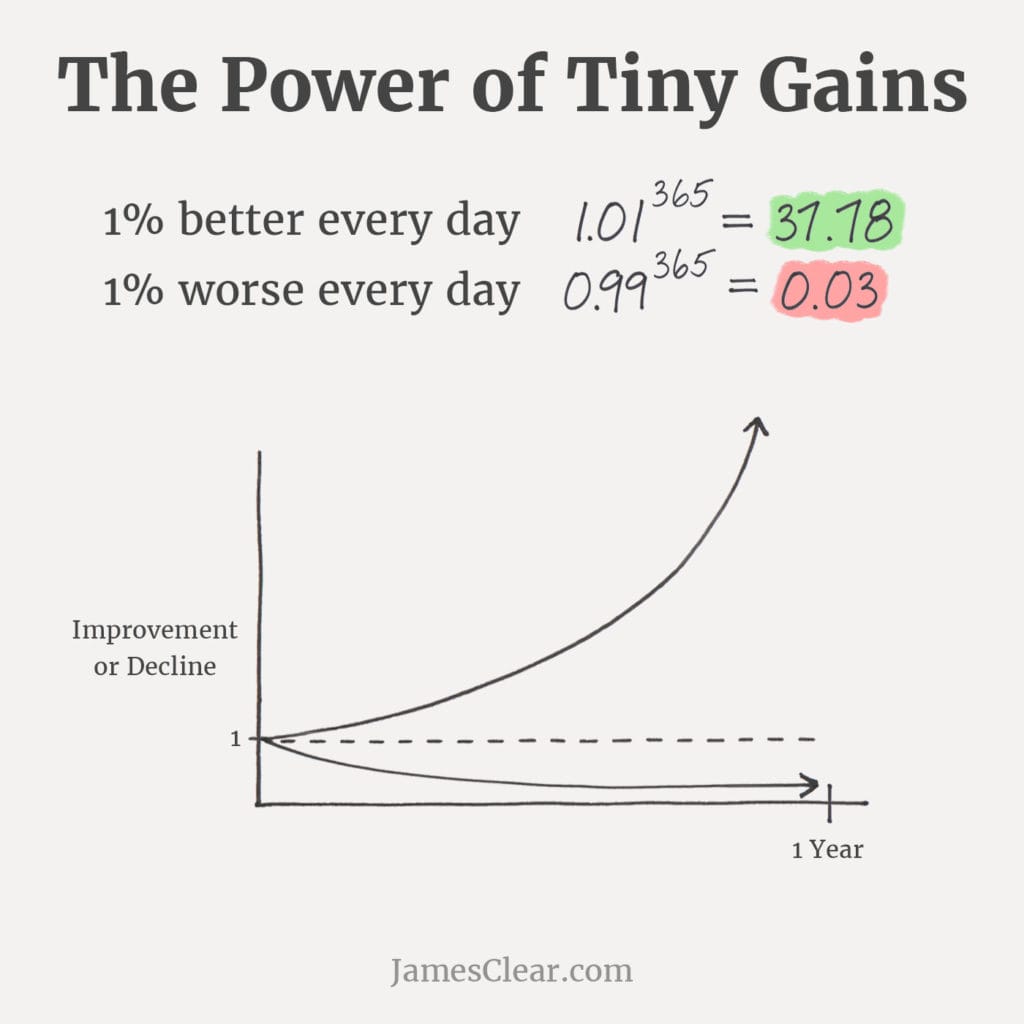
On his website, habit expert James Clear explores the concept of slow and steady ‘continuous improvement’. He advocates for incremental progress, suggesting that improving by just 1% each day will eventually add up and is the best way to sustain improvement in the long term. While it may not be the most glamorous approach, it works.

The image above is taken from James Clear’s blog post on Marginal Gains – I’d really recommend it!

Clear argues that the typical goal-setting approach, where we set a goal and try to achieve it as quickly as possible, often leads to burnout, frustration, and failure. Perhaps you can relate to this if you think back to previous goals or resolutions you’ve made.

However, if we focus on continuously tweaking our habits and behaviours slightly towards our goals, we’ll not only see progress in a more balanced way, but it’s often easier to sustain those positive habits for longer.

I love this model because it’s forgiving and aligns well with our compass points. We’re developing an improvement mindset, not a perfect mindset. Since we’re only trying to improve by 1% each day and we have a clear understanding of our current direction, it’s much easier to pick ourselves up and continue pursuing our goals the next day if things don’t go exactly as planned.

We all have off days, but instead of facing the same crashing and burning cycle that traditional goal-setting or resolution-based approaches can lead to, we can view our improvement from a long-term perspective.

So, let’s aim for slow, sustained progress. We want to get 1% better because we’re not just aiming for short-term goals; we want to sustain these improvements and create healthy habits that will benefit us in the long run.

Being Your Own Self-Improvement Detective

When you try to improve yourself, it’s easy to blame yourself if things don’t go as planned, even if your plans are unrealistic. However, approaching your progress like a detective can help you focus on the system and find the right approach for you.

Imagine you set a goal to do 30 minutes of yoga each morning after you wake up. You go to bed happy, imagining your future-toned self.

The next morning, you wake up to darkness and a chilly room. Your bed is warm and inviting. You think, ‘Just five more minutes in bed won’t hurt’. Then you think, ‘You don’t have to start right away’. ‘Maybe just wait for the room to get a little warmer.’

You fall back asleep and wake up annoyed at yourself for not getting out of bed. Self-criticism starts to creep in. Maybe you’ll start tomorrow, or maybe you’re just not a yoga person; maybe you just don’t have the self-discipline.

This is a very common thought process and is one of the main reasons New Year’s resolutions often don’t work. People rely solely on self-discipline without making any other changes and expect different results. MuchelleB aptly points this out in her video on how discipline doesn’t work. Relying solely on self-discipline is unhelpful because when you fail, you blame yourself, get demotivated, and end up giving up.

However, if you take a detective’s approach, you can start to explore why things didn’t work. Then experiment with different techniques and tweaks to your approach. Maybe you move your alarm across the room so you have to get out of bed to turn it off. Perhaps you sleep in your yoga clothes so you’re ready when you get up. You might even adopt Mel Robbins’ 5-second rule and pretend you’re a rocket, counting down from 5 before launching yourself out of bed!

The key is to try out different techniques – keep what works and ditch what doesn’t. And if something doesn’t work, it’s simply because you haven’t found the right system yet. Everyone’s system will be slightly different, and it may vary depending on the day, time, and energy levels – but it’s a puzzle that can be solved. So, put on your detective hat and challenge yourself to figure it out.

Conclusion – Developing an Improvement Mindset

These three mindsets – focusing on what you can control, embracing slow and steady progress, and becoming your own self-improvement detective – will serve as valuable tools on your personal growth journey. This week’s worksheet will help you assess your current thought patterns and reflect on these concepts further. We’ll continue to revisit and adopt these mindsets over the next three weeks of the course.

As always, remember to share your progress with the other participants in the comments section below. Did any of these concepts strike a chord with you? I’d love to hear your thoughts.

In Week 4, we’ll explore how best to plan and set goals for success. If you missed the previous post on Finding your Compass Point check it out here.

Have a great week everyone, and I’ll see you next time.

Stephen

Categories
Coaching New Years Reset Course 2021

What is Your Compass Point? How to Find Direction in Life

https://youtu.be/aXyL6RsTUsk

Hey everyone, Stephen here. In Week 1 of our New Year’s Reset, we talked about finding your pillars of a successful life. This week, we’re going to build on that foundation and talk about how to find your compass point.

What’s a ‘Compass Point’?

Think of your compass point as the direction you want your life to go in right now. It doesn’t have to be a specific destination, but it should be a general direction that you want to head in. For example, your compass point might be to:

  • Live a more meaningful life
  • Be more successful in your career
  • Be simply happier

Once you know your compass point, you can use it to guide your decisions and make sure that you’re on the right track. For example, if your compass point is to live a more meaningful life, you might decide to:

  • Spend more time with your loved ones
  • Volunteer for a cause you care about
  • Pursue a passion project

How do I Find my Compass Point?

Finding your compass point is a simple but powerful exercise. Here are a few steps to help you get started:

  1. Take some time to reflect on your values and goals. What is important to you in life? What do you want to achieve?
  2. Imagine your ideal future. What would your life look like if you were living your best life?
  3. Identify a destination that is aligned with your values and goals. This is your compass point.
  4. Develop a plan for how you will reach your compass point. This doesn’t have to be a detailed plan, but it should give you a general idea of the steps you need to take.

Remember, your compass point can change over time. That’s okay! As you grow and learn, your values and goals may change as well. Simply revisit your compass point regularly and make adjustments as needed.

Finding your compass point is an important step in creating a life that you love. It gives you a sense of direction and purpose. If you’re feeling lost or overwhelmed, I encourage you to take some time to reflect on your values and goals and identify your compass point. It’s a decision that you won’t regret.

Conclusion

Download my free worksheet to help you find your compass point.

See you next time for week 3, where we’ll be moving on from the ‘Direction’ module and exploring the ‘Mindsets’ that will set you up for success when we start taking action in week 4. 

Have a good week everyone, and I’ll see you next time.

Stephen

This post is part of the ‘New Years Reset Course’ – find details of the course here and the previous post on finding your pillars here

Categories
Coaching New Years Reset Course 2021

Pillars of Success: What are yours?

https://youtu.be/GLHx8E7LDus

Do you know what your pillars of success are? Discover how to define your own personal pillars and use them to achieve your goals in this blog post.

About a year ago I discovered a clip of a commencement speech given by Matthew McConaughey that completely changed the way I think about success. If you have a spare 46 minutes, I’d recommend watching the full video.

About 11 minutes in, McConaughey starts talking about how he measures his success in life by using five pillars: fatherhood, being a good husband, career, health and friendships. Every day, he checks in to make sure that he’s not prioritising one pillar over the others too much; and if he is, he takes steps to correct it. As long as he’s putting time into all these pillars, in a balanced way, he knows he’s on the right track.

Why pillars of success are important

For most of us, outside of getting a certificate or winning a trophy, life rarely provides us with an objective measure of how we’re doing. Instead, we’re often running on the hamster wheel chasing something that doesn’t exist, because there is always more that can be done. The next promotion, a way to make more money, or gain more followers.

That’s why it’s important to define your own personal pillars of success. Your pillars should be the areas of your life that are most important to you. They could be anything from your relationships to your career to your health to your hobbies.

Once you know what your pillars are, you can use them to guide your decision-making and focus your time and energy on the things that matter most to you.

Here are three reasons why having pillars of success is important:

  • They help you stay balanced. It’s easy to get caught up in one area of your life and neglect the others. But by defining your pillars, you can make sure that you’re giving attention to all the areas of your life that are important to you.
  • They help you make better decisions. When you know what your pillars are, it’s easier to make decisions that are aligned with your values and goals.
  • They help you stay motivated. When you have a clear vision of what success means to you, it’s easier to stay motivated and keep working towards your goals.

Defining your pillars of success

So, how do you define your pillars of success? Here are a few tips:

  • Think about what’s most important to you in life. What are your values? What do you want to achieve?
  • Consider all areas of your life. Don’t just focus on your career or your relationships. Think about your health, your hobbies, and your personal development as well.
  • Be honest with yourself. Don’t choose the pillars you think you should have. Choose the pillars that are truly important to you.

Once you have a list of potential pillars, take some time to reflect on which ones are most important to you. Download my free worksheet to help discover your pillars.

It’s also important to note that your pillars of success may change over time. That’s okay! Simply revisit your pillars regularly and make adjustments as needed.

Using your pillars

Once you know what your pillars of success are, you can use them to guide your decision-making and focus your time and energy on the things that matter most to you.

Here are a few tips:

  • When making a decision, ask yourself: “Is this decision aligned with my pillars of success?” If it’s not, then it’s probably not the right decision for you.
  • When setting goals, make sure that they are aligned with your pillars of success. If they’re not, then you’re less likely to achieve them.
  • When planning your day or week, schedule time for activities that support your pillars of success. For example, if one of your pillars of success is your health, then you might schedule time for exercise and healthy meals.

By using your pillars of success to guide your decision-making and focus your time and energy, you can create a more balanced and fulfilling life.

Conclusion

Defining your pillars of success is an important step in creating a more balanced and fulfilling life. By taking the time to reflect on what’s most important to you and setting goals that are aligned with your pillars of success, you can create a life that you love.

Finding your pillars is part of my New Years Reset course, which is introduced here. Find the next post “Finding your compass point” here.

What are your pillars of success? Share them in the comments below.

See you next time

Stephen

Categories
Coaching New Years Reset Course 2021

New Year’s Reset: The Model

https://youtu.be/trYKKmnhzQs

Hey everyone,

In this blog post and the accompanying video, I’ll introduce the model we’ll use over the next six weeks to help us nail 2021.

The model is a collection of different concepts I use in coaching that when combined, have provided my clients with everything they need to develop their own framework for improvement, changing behaviour, and achieving their personal goals.

Combining these concepts will give your improvement planning enough structure to consider all the angles, while also giving you enough flexibility to personalize the system to include the techniques and methods that work for you.

The Model

The Phases

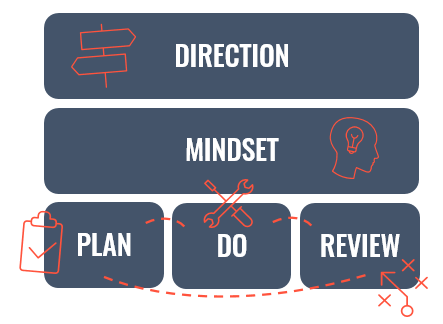
Here are the three different phases you need to consider when wanting to implement a positive change for yourself:

  1. Direction: The first phase is to understand the direction you want to go in your life at this time. This is your compass point, the overall aims or goals that you want to achieve. Once we have a direction, we use this to focus our actions and decisions in the next phases of the model. Without direction, you risk being reactive or feeling like you’re constantly busy, without making any progress. Direction is what will give purpose to your actions.
  2. Mindset: We’ll then look at having the right mindset for positive change and improvements. We’ll treat improvement as a journey and recognize that we’re humans, with our fluctuating moods, emotions, and energy levels all having an impact on our progress. Up and down weeks are normal, and it’s important to recognize that it’s not the end of the world if we have an off-week. Without the right mindset, you risk getting frustrated with the process or giving up early.
  3. Mindful Action: Plan-do-review is an example of mindful action and is a common model in change. After the theory of the first two steps, this is the practical element, where all the doing happens. Following this step will ensure that our actions are considered and mindful. We’ll experiment, continue with what works for us, and drop what doesn’t.

The Schedule

Each week of this course, we’ll dive deeper into one of these concepts, as well as look at some examples of tools and techniques you can use to create a system that works for you.

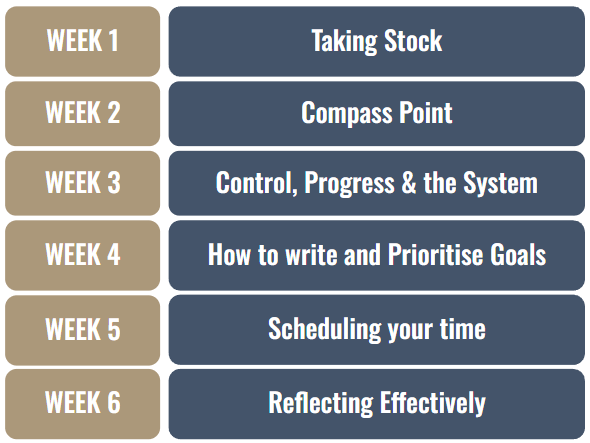
For weeks 1 and 2, we’ll focus on the “Direction” module. This will involve us taking stock of where we are in the first week, and during the second week, we’ll work on finding our compass point/aim to guide our actions for the rest of the course.

In week 3, we’ll look at our mindset – how to focus on the things within our control, a new model for progress, and how to be your own detective to focus on the system.

Then, weeks 4, 5, and 6 will be covering all the aspects of mindful action – exploring how best to plan, do, and review your goals and progress.

I guarantee that if you schedule the time to complete the exercises each week, you will see an improvement in your direction, mindset, and relationship with goal-setting and self-improvement.

If you’re interested in going through this with us then sign up to our Discord, or subscribe to the YouTube channel for more videos. We’ll be starting week 1 of the course in the next post – I hope to see you there.

Stephen

Categories
Coaching New Years Reset Course 2021

New Year’s Reset: A Free Coaching Framework

Hey everyone,

2020 has been a wild ride, hasn’t it? It’s been a year of ups and downs for everyone. What better time for a bit of a New Year’s Reset?

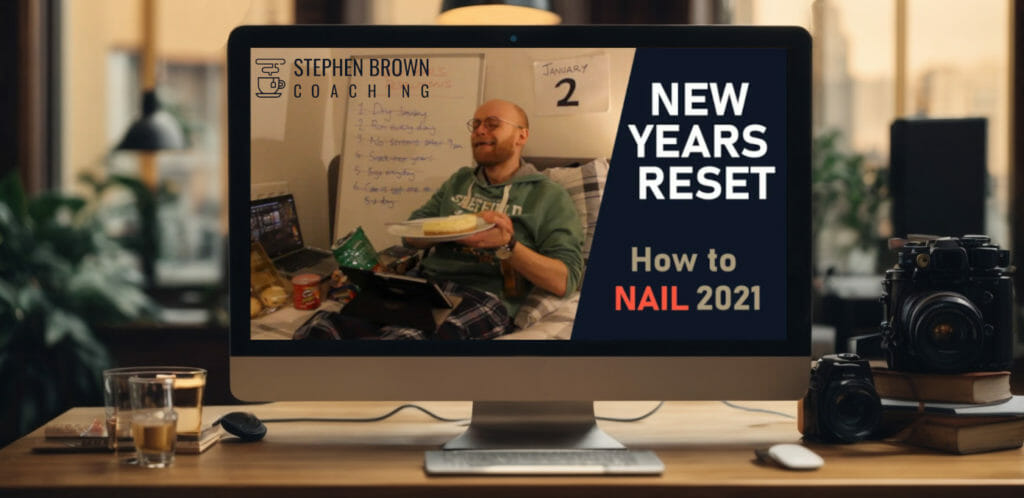
That’s why I’m excited to announce my new YouTube course, New Year’s Reset: A Free Coaching Framework to Help You Nail 2023.

I know what you’re thinking: “Another New Year’s resolution course? Haven’t we seen enough of those?”

But trust me, this one is different.

Instead of giving you a list of generic resolutions to follow, I’m going to teach you a simple framework that you can use to develop your own personalised system for achieving your goals.

Over the course of six weeks, I’ll send out a weekly video introducing a new concept and suggesting ways to put it into practice.

By the end of the course, you’ll have a framework that you can use to achieve any goal you set your mind to.

And the best part is, it’s completely free!

So are you ready to start 2021 off on the right foot? Sign up for my New Year’s Reset course today!

Click here to head over to YouTube and subscribe for free. Or hop over to the next post where we’ll introduce the model we’ll be using.

I hope to see you there!

Cheers, Stephen

https://youtu.be/1ps87YBkOZw
Categories
Bristol Coaching Life Coaching

Life Coaching: Improve Your Life, One Small Change at a Time

[et_pb_section fb_built=”1″ _builder_version=”4.16″ global_colors_info=”{}”][et_pb_row _builder_version=”4.16″ background_size=”initial” background_position=”top_left” background_repeat=”repeat” global_colors_info=”{}”][et_pb_column type=”4_4″ _builder_version=”4.16″ custom_padding=”|||” global_colors_info=”{}” custom_padding__hover=”|||”][et_pb_text _builder_version=”4.16″ background_size=”initial” background_position=”top_left” background_repeat=”repeat” global_colors_info=”{}”]

Welcome to my blog! I’m Stephen Brown, a psychologist and life coach with over a decade of experience based in Bristol, UK. I’m here to share my insights and practical tips on life coaching and how it can help you improve your life.


I’ve noticed that many of my clients are looking to explore and achieve similar things from coaching. That’s why I’m excited to share my knowledge and help you live a better life.


As a coach, my main goal is to help you understand where you are, and where you want to be, and create a plan to get there. However, I can only work with so many people on a one-to-one basis. That’s why I created this blog to provide free guidance and reach more people.


If you stick around and experiment with some of these ideas, I’m confident you’ll find something that will have a positive impact on your life. I believe that many small improvements can add up to a big difference. That’s why I’ll be sharing practical tips that you can implement right away.


I’ll be covering a variety of topics, including:
– Personal development
– Self-improvement
– Psychology
– Leadership
And anything else related to how we navigate life


If you’re interested in learning more about life coaching or getting personalised support, please contact me today.


If you’re interested in improving your life, then this blog is for you. Whether you’re looking to make a change in your career, relationships, or overall well-being, I’m here to help. (Why not start by checking out my ‘New Year’s Reset Course‘?)


Subscribe to my blog today and start making small changes that will lead to a big difference in your life.


Speak to you soon,


Stephen


[/et_pb_text][/et_pb_column][/et_pb_row][/et_pb_section]